- Overview
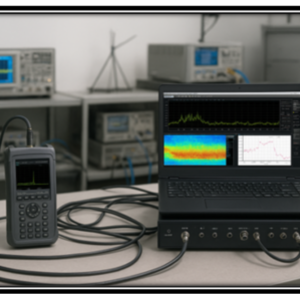
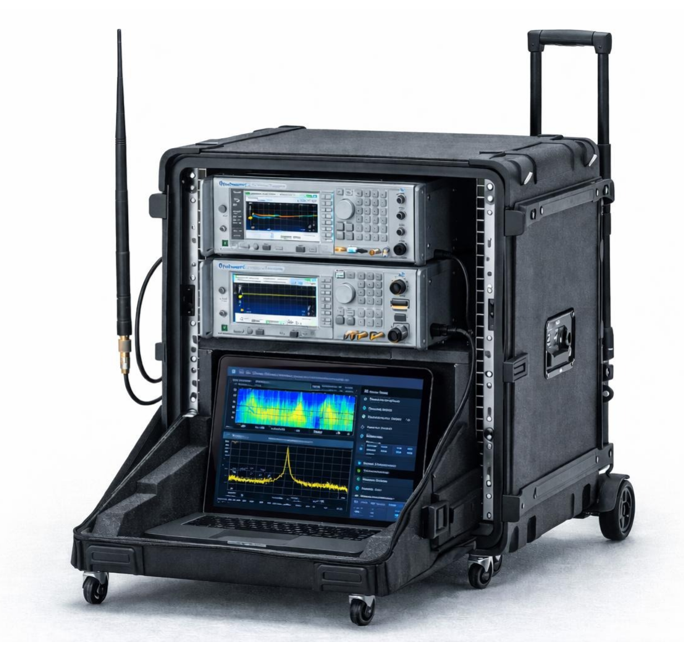
The SYSTEM conducts field testing of communication transmitters operating within the frequency range of 100 MHz to 600 MHz in order to evaluate the technical performance parameters of radio equipment under actual deployment and operating conditions. The system performs continuous transmission power testing and real-time monitoring to ensure stable and compliant operation. In the event of abnormal deviations, performance degradation, or transmitter faults, the system will automatically issue alerts, record corresponding errors, and store detailed fault information for subsequent analysis.
The SYSTEM measures and evaluates key signal parameters of radio communication equipment, including transmission frequency range, output signal strength, and received signal levels from external radio terminals. The measurement results are used to assess the influence of terrain characteristics, environmental conditions, and surrounding interference sources on radio propagation capability, as well as to compare actual field performance against standard reference conditions defined for ideal environments.
The Main Control Module manages the parameter configuration process for each measuring device, corresponding to specific measurement procedures and target test objects. The collected data is then analyzed and evaluated by the system to support technical condition assessment and enable rapid and accurate fault detection (if any).
The system supports the measurement and analysis of high-frequency RF signals across the 0.1 to 1 GHz frequency range, with a maximum continuous-wave (CW) input power of 50 W.
Additionally, the SYSTEM supports spectrum analysis with high frequency resolution and dynamic range to detect interference sources and signal anomalies more effectively. It also integrates GPS-based positioning for precise geolocation of measurement points, enabling accurate mapping of signal coverage and facilitating detailed analysis of radio propagation performance across different terrains.
- Specifications
3.1 RF Signal Analysis Module
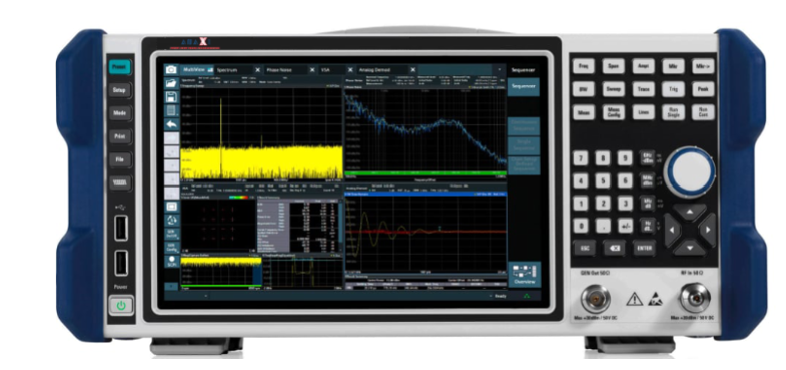
- Pulse measurement functions: Supports pulse waveform and pulse power measurement using zero-span mode
- Remote control capability: Can be controlled from iOS or Android devices via network (VNC or web browser)
- PC connectivity: Supports programming, data storage, and control via LAN, USB, and SCPI commands
- Frequency range: 5 kHz to 7.5 GHz
- Sweep time (span = 0, nominal): 1 μs to 8000 s
- Trigger types: Free run, video, external, IF power
- Resolution bandwidth (non-zero span): Sweep filter from 100 kHz to 10 MHz; FFT filter from 1 Hz to 50 kHz
- Maximum average input power: +35 dBm (with RF attenuation ≥ 10 dB)
- Reference level: –130 dBm to (+30 dBm + attenuation)
- Analysis bandwidth: Standard 12.8 MHz
- Digital modulation analysis: FSK, MSK, PSK, QAM
3.2 Power Testing and Fault Detection Module
- Operating frequency range: 100 MHz to 1000 MHz
- Maximum input pulse power: 50 W
- Power measurement range: ≥ 30 dB
- Displays signal power level
- Automatically detects and evaluates faults based on input signal power
- Connection standard: SMA
3.3 RF Amplifier and Filter Module
- Operating frequency range: 100 MHz to 600 MHz
- Maximum input pulse power: 50 W
- Gain adjustment range: 30 dB
- Adjustment step: 1 dB
- Noise figure: ≤ 5
- Dynamic range: ≥ 50 dB
- Amplification factor (without attenuation): ≥ 20 dB
- Connection standard: SMA
3.4 Interface Connection Module
- Connects the computer with functional control modules
- Provides attenuation control signal for the RF amplifier and filter module
- Bit count: 5
- Control type: Parallel
- Amplitude: 4 ±1 V
- Power supply: 5 V ±5%
3.5 The Main Control Module
- Processor: Intel Core i7
- Memory: 16 GB RAM
- Storage Capacity: 256 GB (Optional: 512GB / 1TB PCIe NVMe SSD)
- Interface Connectivity: USB 3.0, Ethernet
- Temperature Range:
– Operating: -29°C to 63°C / -20°F to 145°F
– Storage: -51°C to 71°C / -60°F to 160°F
Dedicated Measurement and Analysis Software
- Automatically controls measuring instruments according to specific test procedures
- Automatically receives measurement results from the instruments
- Capable of analyzing and calculating measurement results
- Compares processed measurement data with the database to assess faults and provide necessary recommendations
- Measures radio signal parameters: frequency, spectrum width, power level, and harmonics
- Evaluates and automatically reports errors in radio communication equipment parameters: frequency,
spectrum width, and harmonics
- Measures received power at the corresponding deployment location of the equipment
- Compares and evaluates received signals at specific deployment points, providing recommendations as
needed
- Supports data lookup, search, report generation, and printing of test results upon request