- Overview
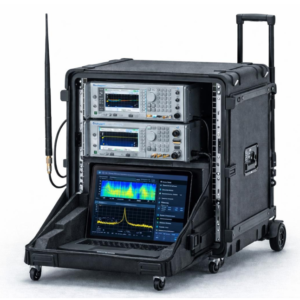
The SYSTEM is designed to inspect and evaluate the parameters and technical specifications of optical fiber cable links connecting different equipment blocks. It ensures compliance with technical standards, enables early fault detection, and supports timely corrective actions to maintain system reliability and operational readiness.
The SYSTEM supports testing of both single-mode and multi-mode fiber links over distances up to 100 km, including configurations with a 1×128 splitter. It measures optical power, insertion loss, return loss, and overall attenuation. It also evaluates connector quality, identifies fiber faults using a visible light source (VFL), and inspects connector end faces, providing effective on-site testing, troubleshooting, and maintenance capabilities.
In addition, the SYSTEMtests data transmission quality by analyzing parameters such as Bit Error Rate (BER), delay, jitter, and packet loss rate. It can monitor and classify hundreds of IP channels, ensuring transmission reliability and performance under real operating conditions.
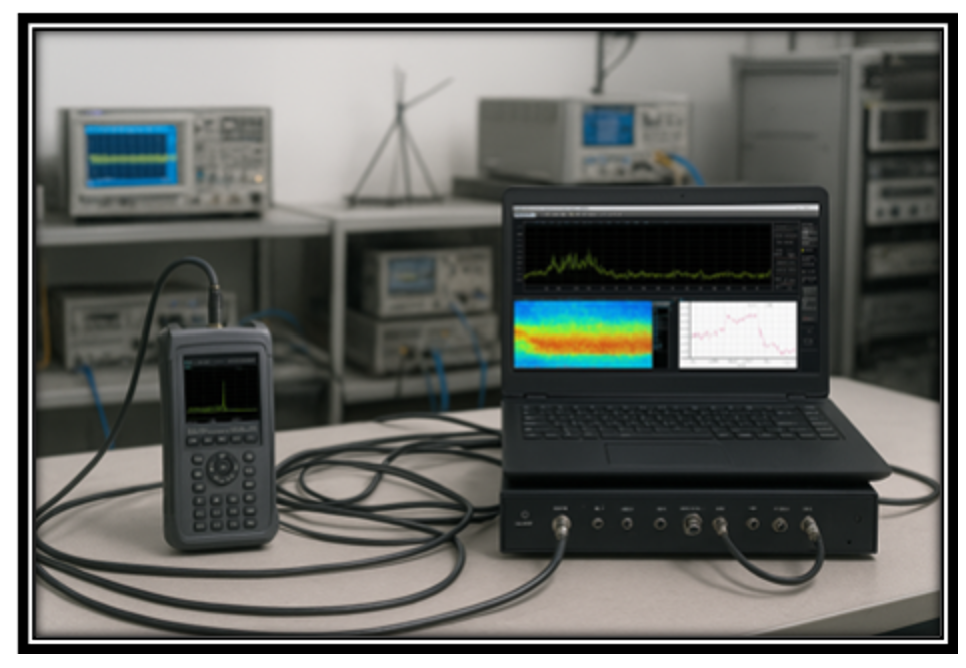
Dedicated software within the SYSTEMenables automated testing, detailed analysis, and clear visualization of results in the form of traces and waveforms, showing fiber length, attenuation, and reflection events. The system also supports the generation of technical reports for acceptance testing, maintenance, and documentation purposes.
- Specifications
3.1 OTDR and Data Transmission Quality Testing Equipment
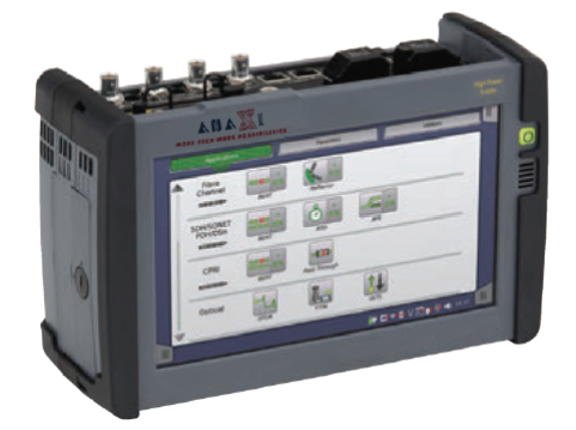
The system features a modular and scalable design that is easy to assemble and disassemble, allowing
integration of additional measurement modules such as high-speed transmission, Ethernet/IP, GPS, and
synchronization. It supports PC interface and Ethernet 10M/100M/1000M connectivity via a standard RJ45
connector for seamless network integration. The platform also supports log file storage and reloading for
analysis and report generation after measurement. A dedicated touchscreen display of at least 9 inches is
integrated into the main unit for convenient operation and monitoring. This architecture provides high
flexibility for both field deployment and laboratory environments while ensuring accurate and reliable
optical network testing and troubleshooting.
Specification
Optical Time Domain Reflectometer (OTDR) Module
- Wavelengths: 1310 nm / 1550 nm ± 25 nm ; 850 nm / 1300 nm ± 30 nm
- Dynamic Range: 42 dB / 41 dB (1310/1550 nm); 29 dB / 28 dB (850/1300 nm)
- Event Dead Zone: Fresnel Dead Zone: ≤ 80 cm (typ.)
Backscatter Dead Zone: ≤ 3.8 m / 4.3 m (1310/1550 nm); ≤ 4.0 m / 5.0 m (850/1300 nm)
- Pulse Widths:
1310/1550 nm: 3, 10, 20, 50, 100, 200, 500, 1000, 2000, 4000, 10000, 20000 ns
1300 nm (MMF): 3, 10, 20, 50, 100, 200, 500, 1000, 2000, 4000 ns
850 nm (MMF): 3, 10, 20, 50, 100, 200, 500 ns
- Sampling Resolution: 0.02, 0.05, 0.1, 0.2, 0.5, 1, 2, 5, 10, 20, 40 m
- Loss Measurement Accuracy (linearity): Not greater than 0.1 dB (total loss) or 0.05 dB/dB (average loss), whichever is greater
- Reflectance Accuracy: Single mode: ±2 dB; Multimode: ±4 dB
- Distance Accuracy: ±1 m ±3 × (Measured distance) ×0.00001 ± marker resolution (excluding IOR inaccuracy)
- Measurement Range (with IOR 1.5):
Single mode: 0.5; 1; 2.5; 5; 10; 25; 50; 100; 200; 300 km
Multimode: 0.5; 1; 2.5; 5; 10; 25; 50; 100 km
- Real-time Scanning Time: lower 0.2 s (Mode: Manual, Range: 50 km, Resolution: Coarse)
- Measurement Modes: Automatic setup, Manual setup, Optical fiber visualization, Trace analysis, Optical source mode, Optical power measurement, Fiber fault detection using a built-in visible light source
Data Transmission Quality Testing Module
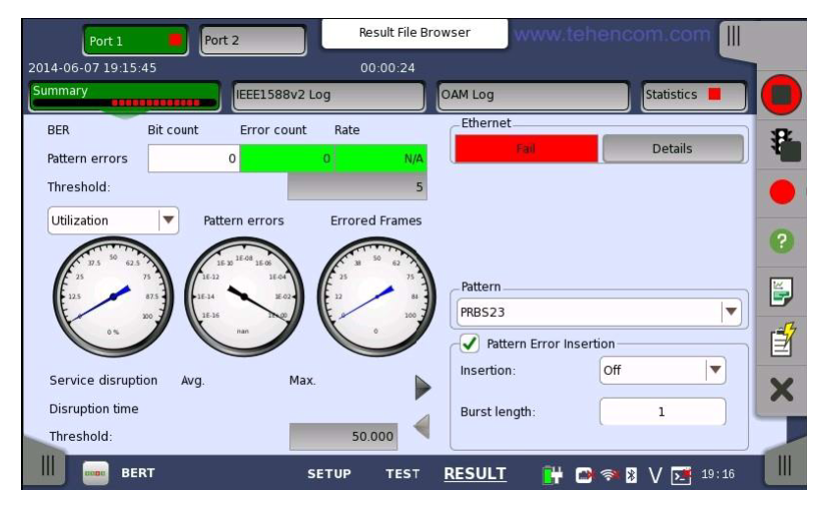
- Measurement Interfaces:
– RJ45: 2 sockets Compliant with IEEE 802.3-2008 (10BASE-T, 100BASE-TX, 1000BASE-T), Auto MDI-X; Supports 10 Mbps /100 Mbps (Full/Half duplex), 1000 Mbps (Full duplex)
– SFP/SFP+/SFP28: 2 slots Compliant with SFF-8402, SFF-8431, SFF-8472, IEEE 802.3ae-2002, IEEE 802.3-2008, IEEE 802.3by
– QSFP+/QSFP28: 1 port Compliant with SFF-8436, SFF-8636, SFF-8665, IEEE 802.3ba-2010
– CFP4: 1 port Compliant with CFP MSA CFP4 Hardware Specification Rev. 1.1, CFP MSA Management Interface Specification V2.2 R06a, IEEE 802.3ba-2010
– 2 Electrical RJ45 ports, 2 optical SFP/SFP+/SFP28 ports, 1 optical QSFP+/QSFP28 port, and 1 optical CFP4 port.
- Measurement Speeds: 10 Mbps (RJ45); 100 Mbps (RJ45/SFP); 1 Gbps (RJ45/SFP); 10 Gbps (SFP+, supporting dual-port simultaneous monitoring in both directions); 25 Gbps (SFP28)
- Measurement Features: RFC 2544; RFC 6349 (1–10G); Y.1564; BERT; Monitor/ Generator; Reflector; Channel Statistics (classification and monitoring of at least 200 simultaneous streams); Ping; Traceroute; Cable Test; 25 GbE FEC; Multi-stream (16 streams per port)
- Supported Protocols: Ethernet; IPv4; IPv6; TCP; UDP; VLAN
Optical Fiber Connector Visual Inspection Probe
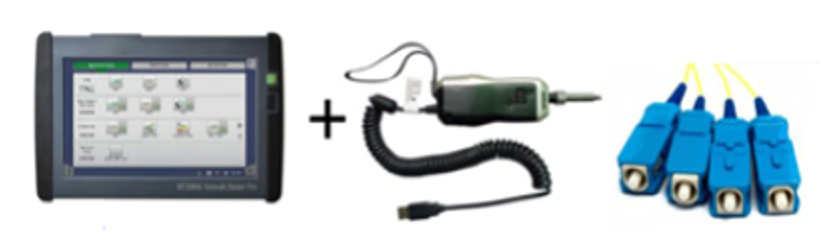
- Optical Focusing: Automatic
- Display: Analysis images shown on the OTDR device screen and via software installed on the central control computer
- Magnification: 400X
- Inspection Capability: Supports inspection of both patch cord connectors and bulkhead adapters
- Specialized Connector Types: Includes 7 types
1.25 mm PC Male (for patch cords)
2.5 mm PC Male (for patch cords)
2.5 mm APC Male (for patch cords)
1.25 mm LC/PC Female (for bulkhead adapters)
2.5 mm FC/PC Female (for bulkhead adapters)
2.5 mm SC/PC Female (for bulkhead adapters)
2.5 mm SC/APC Female (for bulkhead adapters)
3.2 The Main Control Module
- Processor: Intel Core i7
- Memory: 16 GB RAM
- Storage Capacity: 256 GB (Optional: 512GB / 1TB PCIe NVMe SSD)
- Interface Connectivity: USB 3.0, Ethernet
- Temperature Range:
– Operating: -29°C to 63°C / -20°F to 145°F
– Storage: -51°C to 71°C / -60°F to 160°F
Specialized Measurement Software
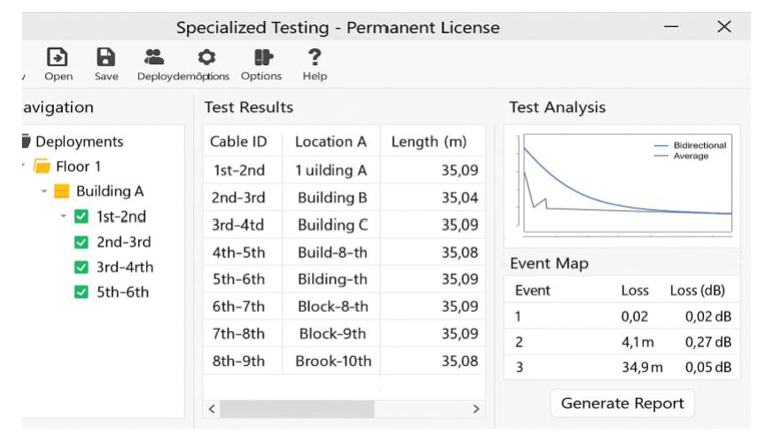
The system provides a perpetual license, supports role-based user access control, performs data acquisition and storage of measurement results, and generates in-depth analytical reports to support technical evaluation and assessment. The software platform is designed with an intuitive interface that enables efficient configuration, monitoring, and management of measurement activities. It also supports centralized data management, allowing users to review historical measurements, compare test results, and maintain traceable records for quality control. In addition, automated reporting and data export capabilities facilitate seamless integration with external analysis tools and documentation workflows. The software features instrument control and measurement process automation.